



Making Herbal Tinctures at Home is perhaps the most fundamental and empowering skill in the practice of herbalism. Tinctures, concentrated liquid extracts of herbs, offer a potent and shelf-stable way to capture and utilize the medicinal properties of plants. They are fast-acting, easy to absorb, and incredibly convenient for modern life. Unlike teas or capsules, a properly prepared tincture can maintain its potency for many years, acting as a reliable, long-term cornerstone of a personal Herbal Apothecary & Resources.
This comprehensive guide will demystify the art and science behind Making Herbal Tinctures at Home, walking you through the selection of herbs, the different extraction methods, the crucial concepts of menstruum and strength ratios, and most importantly, how to safely and effectively dose your finished remedies.
[DISCLAIMER] This article is for informational purposes only and is not intended to be a substitute for professional medical advice, diagnosis, or treatment. Always seek the advice of a qualified healthcare provider with any questions you may have regarding a medical condition or before implementing any new health regimen or supplement.
1. The Power of Tinctures: Why Extract?
Tinctures are created by soaking herbs in a liquid solvent—known as the menstruum—to extract the medicinal compounds. This process offers several key advantages over other preparations:
- Concentration and Bioavailability: Tinctures extract fat-soluble and water-soluble compounds, providing a broad-spectrum representation of the plant’s medicinal properties. The liquid form allows for rapid absorption through the mucous membranes under the tongue.
- Shelf Stability: When using alcohol as the menstruum, the final product is highly stable, often lasting 5-7 years or longer without refrigeration, making them ideal for long-term storage.
- Convenience and Portability: Tinctures are administered in small doses (drops or small spoons), making them easy to carry and take quickly, even when traveling or away from home.
- Customization: Making Herbal Tinctures at Home allows for complete control over the quality of ingredients, the strength of the preparation, and the ability to combine multiple herbs into synergistic formulas.
2. Choosing Your Menstruum: The Solvent Selection
The menstruum is the liquid solvent used to extract the compounds. The choice of menstruum is vital, as different solvents extract different compounds: alcohol extracts resins and alkaloids; water extracts tannins and mucilage; and vinegar and glycerin extract minerals and some vitamins.
A. Alcohol (Ethanol)
Alcohol is the traditional and most efficient menstruum because it is highly effective at extracting a wide array of chemical constituents and acts as a powerful preservative.
- Best Options: High-proof, clear grain alcohol (vodka, brandy, or high-proof neutral grain spirits) is preferred. The standard recommendation is usually between 40% (80 proof) and 50% (100 proof) alcohol.
- Optimal Alcohol Percentage: The strength of the alcohol required depends on the herb being extracted:
- 25% (50 Proof): Best for fresh, juicy herbs like Lemon Balm or Oats, or for extracting minerals and mucilaginous compounds.
- 40-50% (80-100 Proof): The most common range, ideal for dried aerial parts, leaves, and flowers (e.g., Chamomile, Peppermint, St. John’s Wort).
- 60-70% (120-140 Proof): Necessary for tougher, denser material like dried roots, bark, or seeds that contain resins and volatile oils (e.g., Valerian Root, Turmeric, Osha).
- 95% (190 Proof): Used for highly resinous herbs like Propolis or Myrrh, and then diluted down later.
B. Non-Alcoholic Alternatives
For those who must avoid alcohol (children, individuals with specific medical conditions, or personal preference), alternatives are available, though they often result in less potent and shorter-shelf-life extracts.
- Glycerin (Glycerites): Vegetable glycerin is sweet and acts as a decent solvent, primarily extracting water-soluble constituents. Glycerites are safe for all ages, but the extract is less concentrated and shelf life is shorter (1-2 years). Extraction Tip: Use a ratio of 60% Vegetable Glycerin to 40% Distilled Water.
- Apple Cider Vinegar (Acetums): Vinegar extracts minerals well but is a weak solvent for other compounds. Extracts are often sour and best used for compounds like those found in Nettles or Garlic. Shelf life is limited (1-2 years).
3. Understanding Tincture Strength: Ratios vs. Folk Method
The strength of your finished tincture is determined by the ratio of the herb’s weight to the menstruum’s volume, or the method you choose to pack your jar.
A. The Folk Method (Intuitive Method)
This is the traditional, beginner-friendly approach to Making Herbal Tinctures at Home.
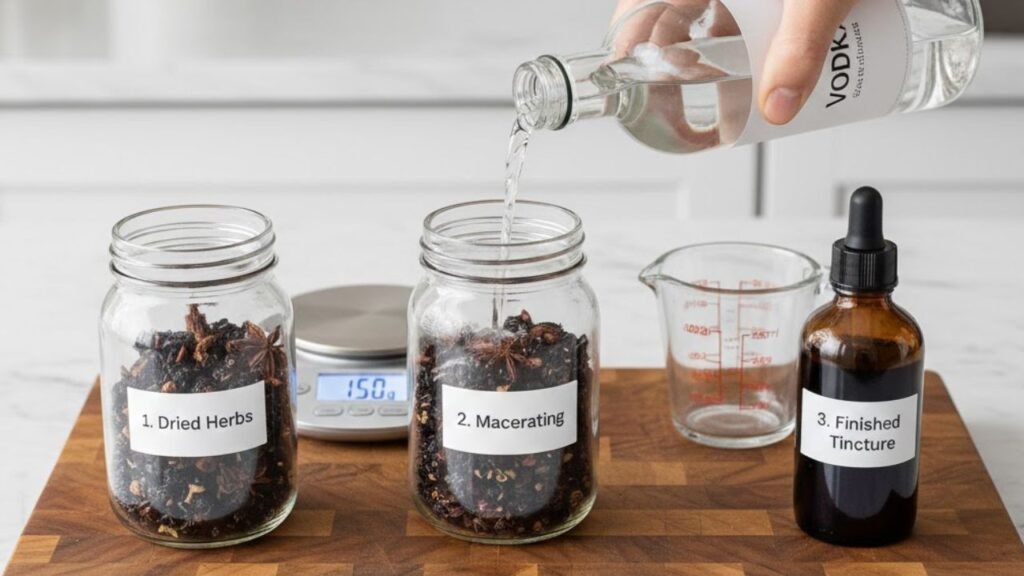
- Preparation: Fill a clean glass jar (a Mason jar is ideal) about half to two-thirds full with dried herb, or three-quarters to the top with fresh herb.
- Menstruum: Pour your chosen alcohol over the herb, completely covering it, and fill the jar to the very top.
- Result: This method generally yields an effective, potent tincture, but the exact strength is unknown and varies widely based on how tightly the herb is packed.
B. The Ratio Method (Scientific Method)
This method, preferred by professional herbalists, ensures a standardized, measurable strength. The ratio is expressed as weight of herb : volume of menstruum (w:v).
- 1:5 Ratio: This is the most common and standard ratio for dried herbs. It means 1 part (gram) of dried herb is soaked in 5 parts (milliliters) of menstruum.
- Example: 100 grams of dried Dandelion Root soaked in 500 mL of 60% alcohol.
- 1:2 Ratio: This ratio is typically reserved for fresh, juicy herbs. Since fresh herbs contain a lot of water (which dilutes the alcohol), you use less menstruum to account for the water content. This results in a much stronger tincture.
Calculating Menstruum Volume (1:5 Example):
If you have 50g of dried herb and want a 1:5 ratio:
$50 \text{g (herb)} \times 5 = 250 \text{mL (menstruum)}$
You would use 250 mL of your chosen alcohol proof.
4. Step-by-Step Tincture Preparation (Ratio Method)
Follow these detailed steps for a successful and standardized tincture preparation:
Step 1: Prepare Your Materials
- Herb: Ensure your herb is properly dried or freshly harvested. If using dried herbs, chop or grind them coarsely to increase the surface area. If using fresh herbs, clean them gently and chop them finely.
- Menstruum: Measure the correct volume and ensure the alcohol proof is suitable for your herb (as per Section 2).
- Vessel: Use clean, sterilized glass jars (amber glass is best to protect from light, but clear is fine if stored in a dark place).
- Labels: Essential for tracking the process. Labels must include: Herb Name, Fresh or Dried, Menstruum Proof, Date Started, and Ratio (e.g., 1:5).
Step 2: Combine the Ingredients
- Place the weighed herb into the glass jar.
- Pour the measured menstruum over the herb.
- Stir or gently shake to ensure the herb is completely saturated and that no air bubbles are trapped. The herb should be fully submerged (“drowning the weed”).
Step 3: The Maceration Period
- Close the jar tightly with a non-metallic lid (metal lids should be lined with parchment paper or plastic wrap to prevent corrosion from the alcohol).
- Store the jar in a cool, dark place (a kitchen cupboard is fine).
- Maceration: The extraction process takes time. Shake the jar vigorously once or twice a day for a period of 4 to 6 weeks. Shaking ensures the herb material is constantly moving and the menstruum can reach all constituents.
Step 4: Pressing and Straining (The Expression)
After the maceration period is complete:
- Strain: Pour the liquid through a fine-mesh sieve lined with muslin or cheesecloth into a clean bowl or container.
- Press: The remaining herb material (the marc) is still saturated with valuable liquid. Gather the cheesecloth and twist it tightly to press out every last drop of the tincture. This is a critical step; discarding the marc without pressing loses potency.
- Filter (Optional): If the liquid is still cloudy, you can let it settle overnight and carefully decant, or run it through a coffee filter.
Step 5: Bottling and Storage
- Pour the finished tincture into sterilized, dark amber dropper bottles. The dark glass protects the extract from light degradation.
- Final Labeling: Apply a permanent label to the bottle with the Herb Name, Date Finished, and the Dosage Instructions (e.g., 2 mL, 3x daily).
- Store in a cool, dark place.
5. Dosage and Safety: Using Your Homemade Tinctures
The final and most important step in Making Herbal Tinctures at Home is knowing how to use them safely and effectively.
A. Standard Tincture Dosage
The typical professional dosage for a standardized 1:5 (w:v) tincture is:
- Dosage Size: 1 mL to 3 mL per dose.
- Frequency: 1 to 3 times per day, depending on the herb and the condition being addressed.
- Note on Drops: Tinctures are often measured in “drops,” but dropper sizes vary widely. To ensure accuracy, you should calibrate your dropper bottles. A general rule for a standard dropper is that 1 mL equals approximately 20 to 30 drops. Use a measured pipette for the most accurate dosing.
B. How to Take a Tincture
- Sublingually: The most effective method is to drop the measured dose directly under the tongue. Hold it there for 30–60 seconds for rapid absorption before swallowing.
- Dilution: If the taste is too strong or if you are sensitive to alcohol, mix the dose in a small amount of warm water, juice, or tea. The warm liquid will help evaporate some of the alcohol.
C. Safety and Consultation
- Quality Control: Only use high-quality, ethically sourced, and correctly identified herbs. Misidentification can be dangerous.
- Contraindications: Even natural herbs interact with medications and have contraindications (e.g., St. John’s Wort interacts with numerous pharmaceutical drugs, including contraceptives). Always consult a qualified healthcare provider or clinical herbalist before starting any new herbal regimen.
- Children and Alcohol: For children, the minimal amount of alcohol in a dose is generally not a concern, but it can be evaporated by adding the dose to a hot liquid. For zero-alcohol concerns, use the glycerite or acetum alternatives.
6. [OUR TOP PICK] Essential Tincture Making Supplies
Having the right tools simplifies and improves the quality of your homemade tinctures. Our top pick focuses on a durable, accurate, and easy-to-use kit for the straining and pressing phase.
[OUR TOP PICK]: Tincture Press Kit (Amazon UK)
- Why it’s Our Pick: While you can press with cheesecloth, a dedicated tincture press (or even a small fruit/wine press) significantly increases the yield and potency of your finished product. These presses are typically made of stainless steel and ensure you extract the maximum amount of valuable liquid from the marc.
- Key Features: Look for a stainless steel, hand-crank press with a collection spout and fine filter bags. This investment pays for itself quickly through increased extract yield.
7. Troubleshooting and Advanced Techniques
- Mold/Spoilage: If you see any signs of mold, discard the batch immediately. This usually occurs when fresh herbs were not properly dried or when the herb was not fully submerged in the menstruum.
- Cloudiness: Cloudiness after pressing can be normal, particularly with resinous herbs. It is usually just harmless plant material; simply let it settle and decant or filter it out.
- Percolation: An advanced method that involves continuously dripping the menstruum through the herb material, which can achieve extraction in hours rather than weeks, but requires specialized equipment (a percolator).
Conclusion: Mastering the Art of Extraction
Making Herbal Tinctures at Home is a journey that connects modern wellness with ancient wisdom. By mastering the fundamentals—from selecting the correct menstruum proof to calculating precise herb-to-menstruum ratios—you move beyond simple folk remedies to create professional-grade, potent, and highly effective botanical medicines.
Tinctures offer a powerful, stable, and convenient method for delivering the healing essence of the plant kingdom. Embrace the control and customization that comes with homemade preparations, and enjoy the confidence of having your own, reliable line of Herbal Teas & Tinctures ready in your personal apothecary.
Information on Alcohol Proof and Extraction: “optimal alcohol percentage”
Safety and Contraindications of Herbal Medicine: “Always consult a qualified healthcare provider or clinical herbalist”
Information on Glycerites and Non-Alcoholic Extracts: “Vegetable glycerin is sweet and acts as a decent solvent”
long-term cornerstone of a personal Herbal Apothecary & Resources
can be combined with multiple herbs into synergistic formulas